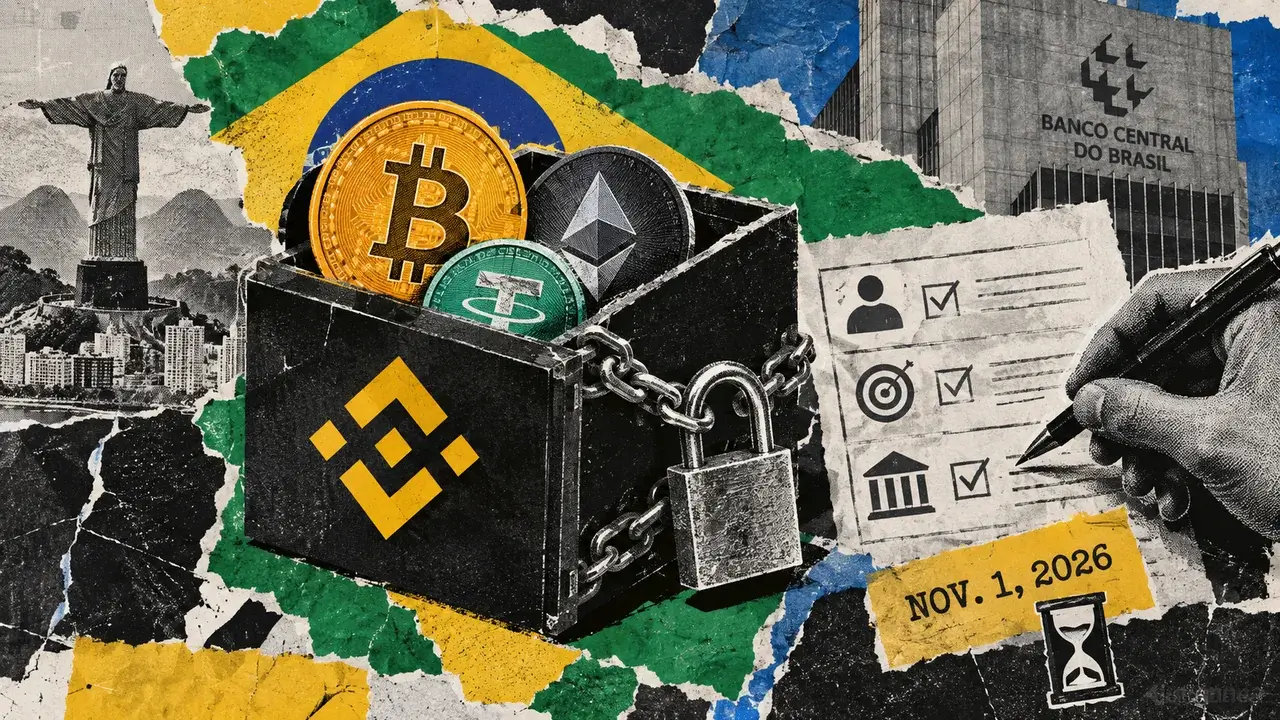
Brazilian Binance users now face a new gate whenever crypto crosses the border. From Nov. 1, the exchange requires customers sending assets abroad, or receiving them from nonresidents, to state the purpose of each transfer and the type of counterparty involved. Withdrawals cannot be submitted until the questionnaire is complete.
The change is less about Binance than about Brazil. Regulators are folding cross-border crypto flows into the country's foreign-exchange rulebook, and the exchange is simply the first large venue to show what that looks like at the customer interface.
Binance will report these transactions monthly to the central bank under Resolution BCB No. 521/2025, which brings international virtual-asset transfers into the foreign-exchange framework. Corporate accounts must also say whether the other party belongs to the same economic group. Transfers between Brazilian residents are unaffected.
The friction is unevenly distributed. Withdrawals stop until the form is filled in, while incoming deposits can sit in a pending state and, in some cases, be returned if the sender fails to supply the required details. For anyone who relies on timing, that asymmetry matters.
Self-hosted wallets follow a separate path. Users do not need to give a transfer purpose, but they must confirm ownership of the wallet, and Binance will report those transactions to the central bank under a distinct category. That mirrors a wider rule requiring regulated institutions to report crypto transfers worth at least $10,000 to or from self-custody wallets to the financial-intelligence unit, Coaf, by the next business day, even when nothing looks suspicious.
Put together, the message to self-custody users is that moving coins off an exchange is still allowed, but it is no longer invisible. Expect more reporting, not fewer options.
The timing is notable because stablecoins are deeply embedded in Brazilian payments. Tax data showed R$1.13 trillion in declared stablecoin transactions between August 2019 and December 2025, about 72% of declared crypto activity. Brazil has also restricted stablecoins and other virtual assets in one specific aggregated payment structure used by foreign-exchange providers. Individual international crypto transfers remain permitted, but settlement between eFX firms and overseas counterparties must now run through licensed FX transactions or qualifying nonresident real accounts.
The scale explains the regulatory interest. Chainalysis estimated that Brazil handled $252.5 billion in crypto between July 2025 and June 2026. Brazil ranked first in the firm's 2026 adoption index and second for cross-border flows, although activity contracted 1.6% over the period. A large, still-adopting market that also moves substantial value abroad is exactly where supervisors want better data.
Cross-border crypto in Brazil is shifting from a product feature to a regulated reporting event.
More tightening is scheduled. Binance says its changes are separate from the Travel Rule, which is due to roll out in phases for domestic transactions in 2027 and international transfers in 2028. On Jan. 1, Resolution BCB 584 introduces precautionary holding procedures that can delay certain outbound virtual-asset transfers while extra checks are carried out.
For investors and researchers following Latin American markets, the practical read is to budget for compliance friction. Brazil is not closing the door on crypto; it is routing it through the same disclosure channels as conventional foreign exchange. Platforms that automate these declarations well will keep users, and those that make the process painful may lose cross-border flow to competitors that do it better. Researchers should also watch whether other exchanges adopt similar questionnaires, since a common standard would show the central bank's framework is becoming the market norm.
Keywords: Binance, Brazil, cross-border transfers, central bank, BCB 521, stablecoins, self-custody, Latin America
Source: CryptoSlate