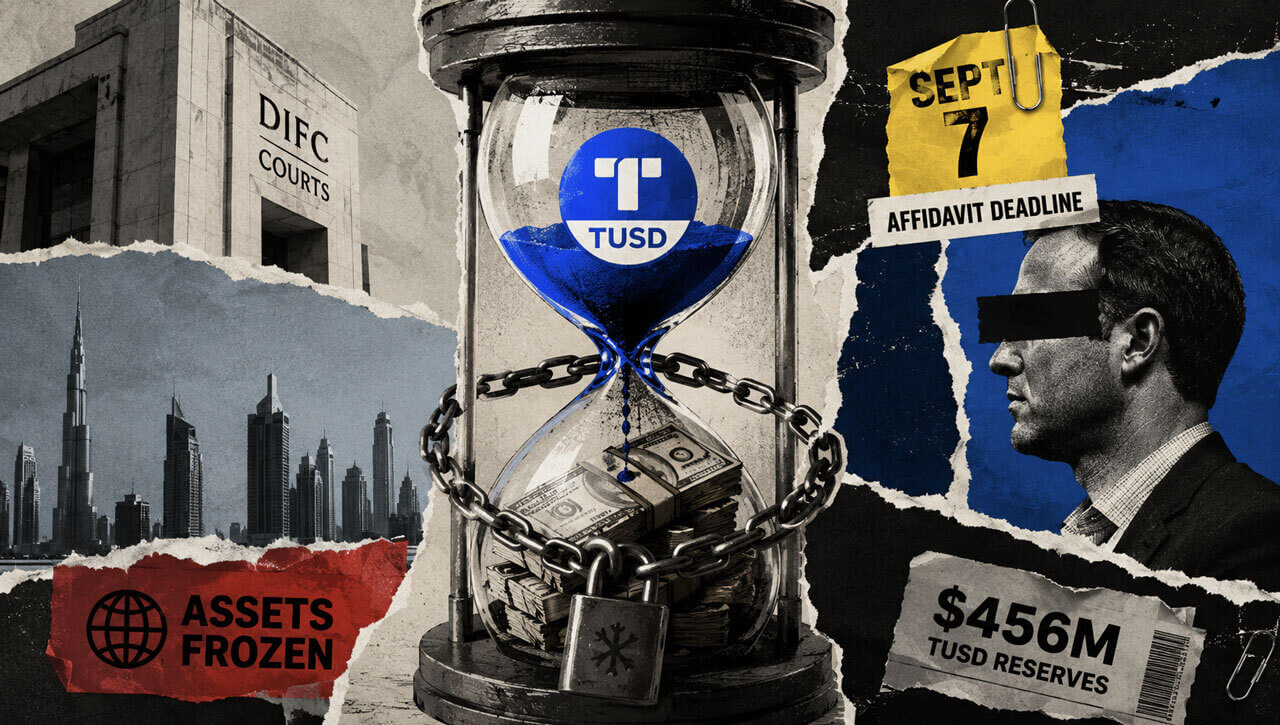
The Dubai International Financial Centre (DIFC) Court has issued a landmark order compelling the defendant in the TrueUSD (TUSD) stablecoin freeze case to disclose the source of funding behind their legal defense — or face court sanctions. The $456 million in frozen TUSD reserves at the center of this dispute has turned the case into the most consequential stablecoin litigation in the Gulf Cooperation Council region, setting a precedent with direct implications for how UAE courts treat digital asset custody, reserve transparency, and cross-border enforcement in crypto disputes.
For regional investors and institutions operating under the UAE's Virtual Assets Regulatory Authority (VARA) framework, the court's order signals that DIFC judges are willing to apply aggressive disclosure mechanisms normally reserved for complex commercial fraud cases to crypto asset disputes. The transparency burden is not falling only on exchanges and issuers — it is now reaching the legal infrastructure surrounding them.
The court issued a mandatory disclosure order requiring the defendant to reveal within days the identity of any third party funding their legal representation in the proceedings over the frozen $456 million TUSD reserve. The order carries the threat of court-imposed sanctions for non-compliance — a mechanism DIFC courts use to enforce transparency in proceedings where hidden financing arrangements could indicate undisclosed beneficial interests or conflicts with the opposing party.
The underlying dispute centers on TrueUSD reserves that were frozen following questions raised about the stablecoin's backing and the identity of parties controlling key custodial relationships. The $456 million figure represents a substantial portion of TUSD's total circulating supply, making the freeze a systemic event rather than an isolated counterparty dispute.
The DIFC is a common law jurisdiction operating within the UAE, with courts that follow English law precedents and maintain enforcement treaties with over 40 jurisdictions. A DIFC judgment carries materially stronger cross-border weight than a ruling from a UAE onshore court — particularly for international institutional creditors and custody counterparties whose assets may be held across multiple jurisdictions simultaneously.
The DIFC's willingness to treat stablecoin reserve disputes with the same disclosure rigor as corporate fraud litigation is a signal to the entire Gulf crypto market: digital asset cases will not receive procedural leniency simply because the underlying instruments are novel. The court is applying established commercial law tools to crypto disputes without hesitation.
For the UAE's broader Virtual Assets Regulatory Authority framework, the case creates a live test of how VARA-licensed entities interact with DIFC dispute resolution mechanisms. VARA's licensing regime covers virtual asset service providers in the Emirate of Dubai but does not extend into the DIFC free zone, which operates under its own regulatory authority. The intersection of these two frameworks is precisely the ambiguity that sophisticated bad actors exploit — and that this case may clarify.
TrueUSD's reserve controversy is not isolated. The TUSD case joins a pattern of stablecoin reserve disputes — including Tether's historical New York AG settlement, BUSD's collapse following the Binance enforcement action, and USDC's temporary depeg during the Silicon Valley Bank crisis — where the gap between claimed and verified backing becomes the central litigation question.
For family offices, sovereign-adjacent investment vehicles, and regulated financial institutions in the UAE, Bahrain, Saudi Arabia, and Qatar that hold stablecoin positions or use stablecoins for cross-border settlement, the DIFC case introduces a concrete reputational and operational risk factor: involvement — even as a creditor or counterparty — in a stablecoin issuer that becomes subject to freeze proceedings could expose asset positions to disclosure orders and asset preservation injunctions.
VARA's licensing conditions already require virtual asset service providers to maintain segregated client assets and publish reserve disclosures. The DIFC case demonstrates that even VARA compliance does not insulate an issuer from common law equitable remedies — including freezing orders and disclosure mandates — when reserve integrity is disputed in a DIFC-seated proceeding.
The TrueUSD case is the first major test of whether Dubai's ambition to become a global crypto hub can coexist with the rule-of-law enforcement rigor that sophisticated institutional capital requires. The DIFC's aggressive use of disclosure tools signals that the answer is yes — but it comes with the same accountability infrastructure that governs every other asset class operating in a mature common law jurisdiction.
Keywords: TrueUSD, TUSD, DIFC, Dubai, stablecoin, VARA, UAE crypto, stablecoin freeze, Middle East crypto, crypto regulation
Source: CryptoSlate