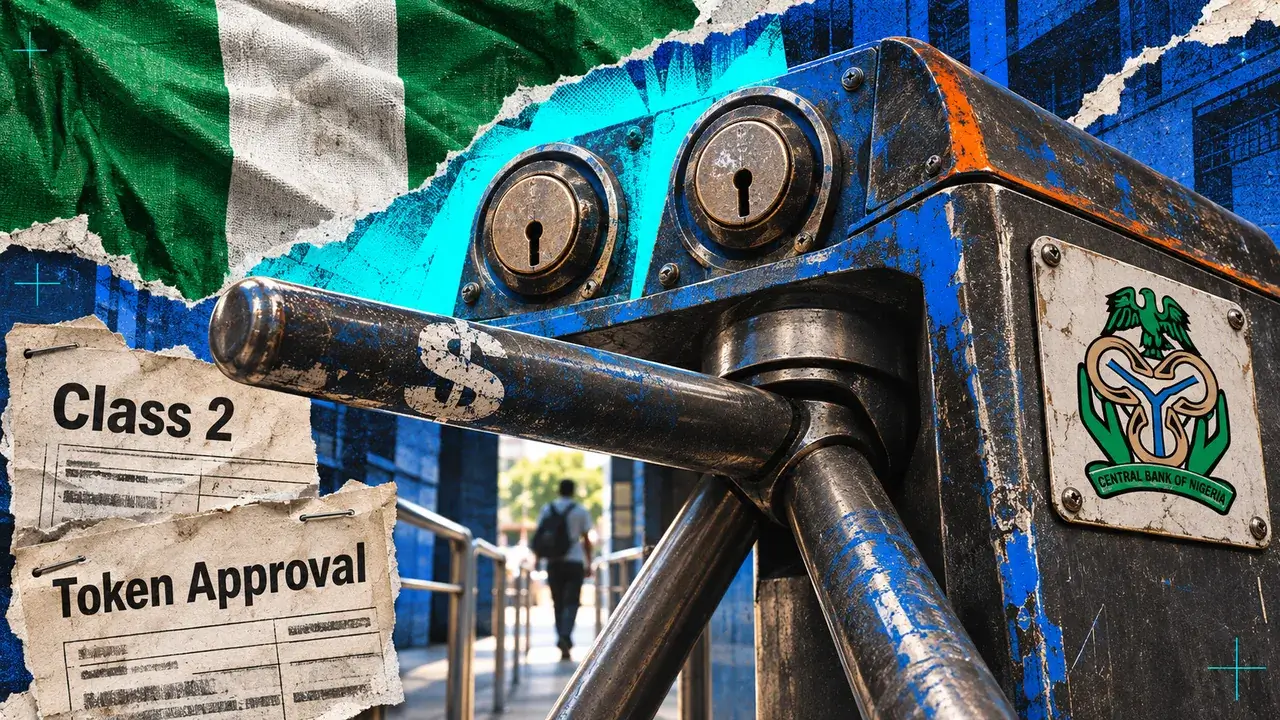
Nigeria's central bank has drawn a hard line for dollar-pegged stablecoins offered to retail customers: the issuer must be a locally incorporated, licensed entity, and the token itself must be approved. The Central Bank of Nigeria (CBN) rules took effect on Nov. 5, 2026, with a conditional 180-day application window for operators that already serve the market.
For a country where dollar stablecoins are widely used as a savings and payment tool, the message is blunt. A foreign license, a foreign regulatory status or a deal with a Nigerian intermediary will not substitute for local approval, and the rules reach activity directed at people in Nigeria even when the provider has no physical presence there.
The regulations classify foreign-currency stablecoins as Class 2. Section 6.5 requires a Nigerian-incorporated entity holding a Foreign Currency Issuer License, together with approval of the token. Issuers and service providers face separate approvals, and a service license does not permit issuance.
Issuer applicants must also build real local substance. Before final licensing they need a staffed Nigerian office and effective local management, including a resident chief compliance officer. That is a far higher bar than listing a token through a local partner.
There is one carve-out. Section 11.10.17 lets the CBN recognize a foreign-issued stablecoin solely for expressly approved wholesale cross-border settlement. That route excludes offerings to Nigerian retail customers, so it is no workaround for the retail rules.
Approval also has limits at home. Class 2 token approval does not authorize using a token to settle, price or discharge a naira-denominated domestic obligation unless foreign-exchange or other law expressly allows it. In practice, the dollar token stays a foreign-currency instrument.
Continued access during the CBN's assessment requires the bank's express interim permission, and it creates no permanent exemption. Filing an application alone does not prove permission to keep serving customers, and operators that miss the deadline must stop until they hold the right license or authorization.
Two things stand out. First, the rules separate who may issue from who may distribute, so a platform that is licensed for other services cannot assume it can handle a dollar token. Second, the regulations preserve the Securities and Exchange Commission's statutory jurisdiction and do not automatically cancel approvals under other Nigerian frameworks, yet an existing principal license still does not remove the need for express CBN approval for non-security virtual asset services.
Nigeria is not banning the dollar token; it is making the issuer, the office and the compliance officer physically accountable inside Nigeria.
For users, the risk is practical rather than legal. If a favorite platform fails to secure interim permission or misses its application deadline, access to its stablecoin offering could pause, and users may need to move funds on short notice.
The broader lesson for African markets is that stablecoin policy is shifting from tolerance to gatekeeping. Regulators want a named, reachable entity to hold accountable, and they are willing to apply that expectation to foreign providers that never opened a local branch.
Watch which operators announce applications, whether the CBN grants express interim permission to the largest platforms, and how it defines scale limits during the transition. Also watch whether wholesale recognition under Section 11.10.17 is used by banks and payment firms. Because the rules took effect on Nov. 5, the 180-day window runs into the first half of next year, and that is when the market structure will become clear.
Keywords: Nigeria, stablecoins, CBN, crypto regulation, Class 2 license, dollar stablecoins, Africa, cross-border settlement
Source: CryptoSlate