Ripple's clearest foothold outside the United States may now be Brazil. About $2.7 billion of the $6.7 billion in tokenised real-world assets that a RippleX executive counted on the XRP Ledger sits in the country, roughly 40% of the reported total, and a new securities-records project adds a regulated infrastructure partner to the mix.
The scale deserves a caveat. The figure measures assets represented on the ledger, not payment activity, and Ripple has not published a Brazil-only payment volume, RLUSD circulation figure or active institutional usage number. It is a footprint, not proof of traffic.
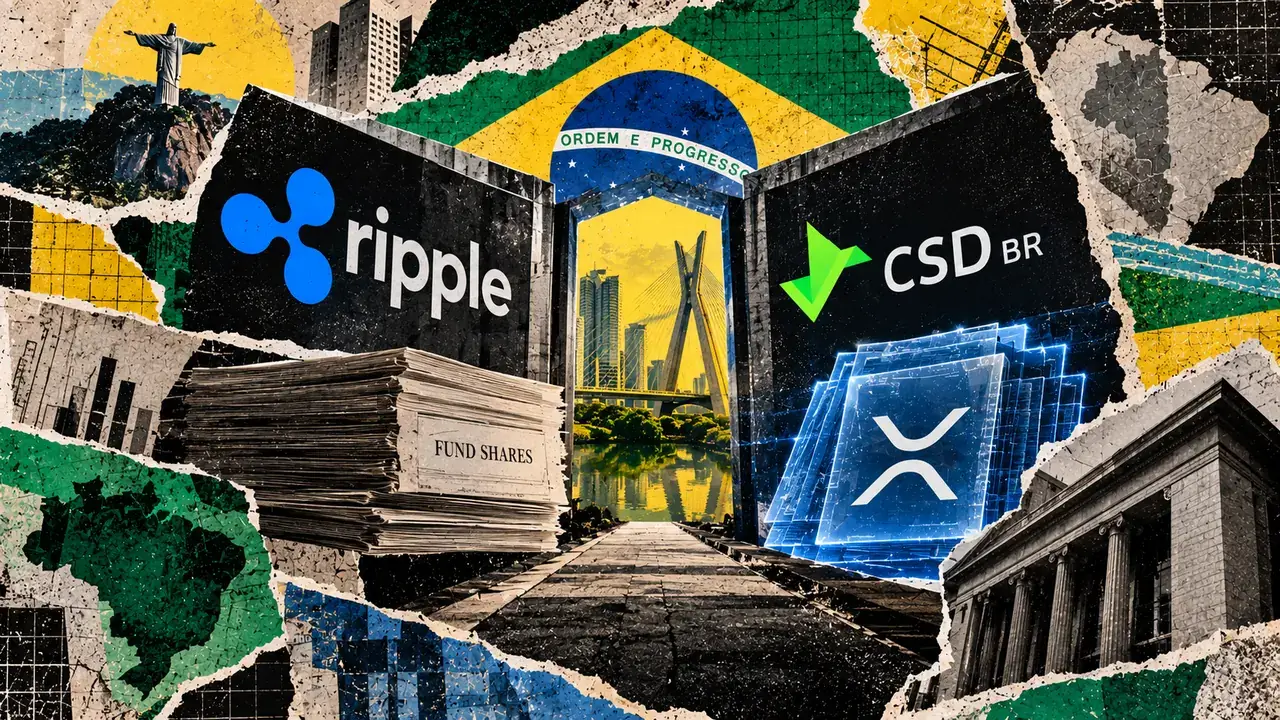
On Sept. 29, Ripple and CSD BR, a regulated financial market infrastructure operator, announced a first phase that mirrors ownership records for BTG Pactual investment fund shares on the XRP Ledger. CSD BR's systems remain the official record for registration, deposit and settlement, so the ledger acts as a parallel copy rather than the authority.
Access is limited to authorised Brazilian corporate and banking participants, subject to identity and anti-money-laundering checks. Native issuance and trading are envisaged only for later phases, once the mirroring approach has been validated. The design lets Ripple sit inside an existing financial process without asking the market to trust a public blockchain as its legal register.
This is not an overnight move. The timeline shows steady accumulation of relationships:
In that March expansion, Banco Genial, Braza Bank and Nomad were named among payments users, while Mercado Bitcoin, Foxbit and Ripio were among the platforms listing or supporting its dollar stablecoin, RLUSD. Ripple also said it planned to seek a Brazilian virtual asset service provider licence. Mercado Bitcoin appears again on the asset side, having announced in July 2025 plans to tokenise more than $200 million in permissioned real-world assets on the ledger.
The backdrop is a country Chainalysis ranks first overall in its 2026 adoption index, second for cross-border flows, third for service flows and domestic peer-to-peer activity, and fourth for balances. The ranking uses a revised methodology that rewards breadth, so first place does not mean the largest market by raw dollar volume, and comparisons with earlier years are limited.
Chainalysis estimated $252.5 billion in Brazilian crypto activity between July 2025 and June 2026, yet the same report found the crypto economy contracted 1.6% over the period. Adoption leadership and a slowdown can coexist. The more useful detail for Ripple is how companies use crypto: for liquidity management and cross-border transfers, purposes that overlap with its institutional pitch.
Brazil is a practical test of whether institutional crypto infrastructure can win business by fitting existing rules rather than replacing them.
Brazil's Oct. 1 restrictions bar virtual assets from settling aggregated eFX flows between providers and foreign counterparties, although individual international transfers remain permitted. That narrows one use case for stablecoin-based settlement while leaving others open, and it shows that opportunity and limits are arriving together.
For readers focused on emerging markets, the lesson is to separate the layers. Reported asset value, pilot projects and partnership announcements are early indicators. Sustained transactions and wider use of the CSD BR system would show whether these connections turn into recurring business. Until then, treat Brazil as Ripple's most promising laboratory rather than a proven revenue engine. Watch for disclosed transaction volumes, licence progress and the move from mirrored records to native issuance, because those are the markers that would separate durable adoption from a well-publicised pilot.
Keywords: Ripple, XRP Ledger, Brazil, tokenization, RLUSD, CSD BR, Chainalysis, Latin America
Source: CryptoSlate