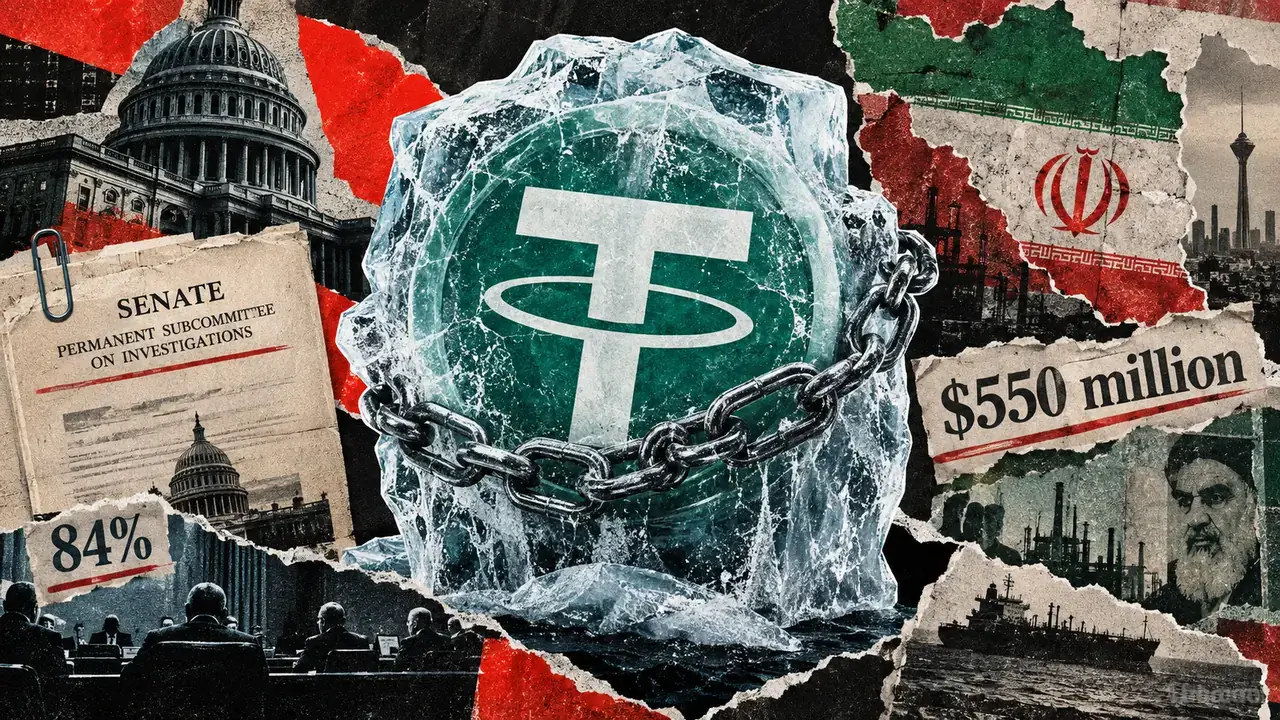
Tether froze over $550 million in USDT linked to Iran-connected wallets in 2026 — yet a U.S. Senate investigation found that delays in blacklisting known addresses allowed at least $34.6 million to escape, exposing a structural compliance gap that carries direct consequences for stablecoin users across the Middle East and emerging markets.
The Senate Permanent Subcommittee on Investigations released its minority report on September 28, 2026, examining 846 crypto wallets sanctioned or targeted by U.S. or Israeli authorities for connections to Iran. The finding that reverberated hardest: 84% of those wallets transacted exclusively or nearly exclusively in USDT — making Tether the dominant stablecoin of choice in sanctioned corridors.
Investigators focused on 39 wallets identified by Israel's National Bureau for Counter Terror Financing in June 2023, linked to Tawfiq Muhammad Sa'id al-Law — later sanctioned by the U.S. Treasury for providing financial services to Hezbollah. Five addresses were frozen promptly. The remaining 34 were not blacklisted until March 2024, a nine-month gap during which $34.6 million in USDT continued to move freely.
This is not a story about Tether refusing to cooperate. The company says it acted each time it received "credible information" from authorities. The problem is structural: Tether can only freeze addresses it knows about. Between the moment investigators identify a wallet and the moment Tether is formally notified, funds can — and did — move out.
USDT is not merely a trading instrument in the Middle East — it is infrastructure. In Iran, Turkey, Egypt, and across sub-Saharan Africa, dollar-pegged stablecoins serve as savings vehicles, remittance rails, and hedges against local currency depreciation. The Senate report's finding that 84% of Iran-sanctioned wallet activity ran through USDT is a reflection of that deep utility.
For legitimate users in these regions, the report raises two distinct risks. First, guilt-by-association exposure: if a counterparty later appears on a sanctions list, funds already received may be subject to retrospective freezing. Second, infrastructure risk: any regulatory action that constrains Tether's operations — whether licensing requirements, reserve audits, or enforcement orders — would immediately affect the stablecoin liquidity that regional economies have quietly come to depend on.
Senator Richard Blumenthal referred the findings to the Treasury and Justice departments, requesting investigation into whether the identified delays represent "isolated gaps or broader compliance failures" — a framing that signals potential regulatory escalation beyond this single report.
Tether CEO Paolo Ardoino pointed to a genuine advantage of public blockchains: every transaction is auditable in a way that traditional banking transfers are not. That transparency has allowed post-hoc reconstruction of fund flows and, ultimately, enabled the freezes Tether is citing. The Senate is not disputing the freezes happened — it is questioning whether the notification pipeline between government intelligence and stablecoin issuers is fast enough to close the gap.
The core compliance architecture challenge is timing. Tether's issuer-level controls are technically effective once an address is on its blacklist. The vulnerability lies in the interval between identification and notification — a window that Senate investigators documented as lasting up to nine months. Closing that window would require either direct real-time data sharing between intelligence agencies and Tether, or a regulatory mandate that Tether proactively monitor flagged jurisdictions with lower identification thresholds.
The $550 million figure Tether leads with is real and significant. So is the $34.6 million that moved before the freeze arrived. For investors operating in markets where USDT is the default settlement layer, understanding both numbers — and the compliance gap between them — is essential context for 2026 and beyond.
Keywords: Tether, Iran, USDT freeze, Senate report, sanctions compliance, stablecoin regulation, Middle East crypto, OFAC, emerging markets, Hezbollah
Source: CryptoSlate