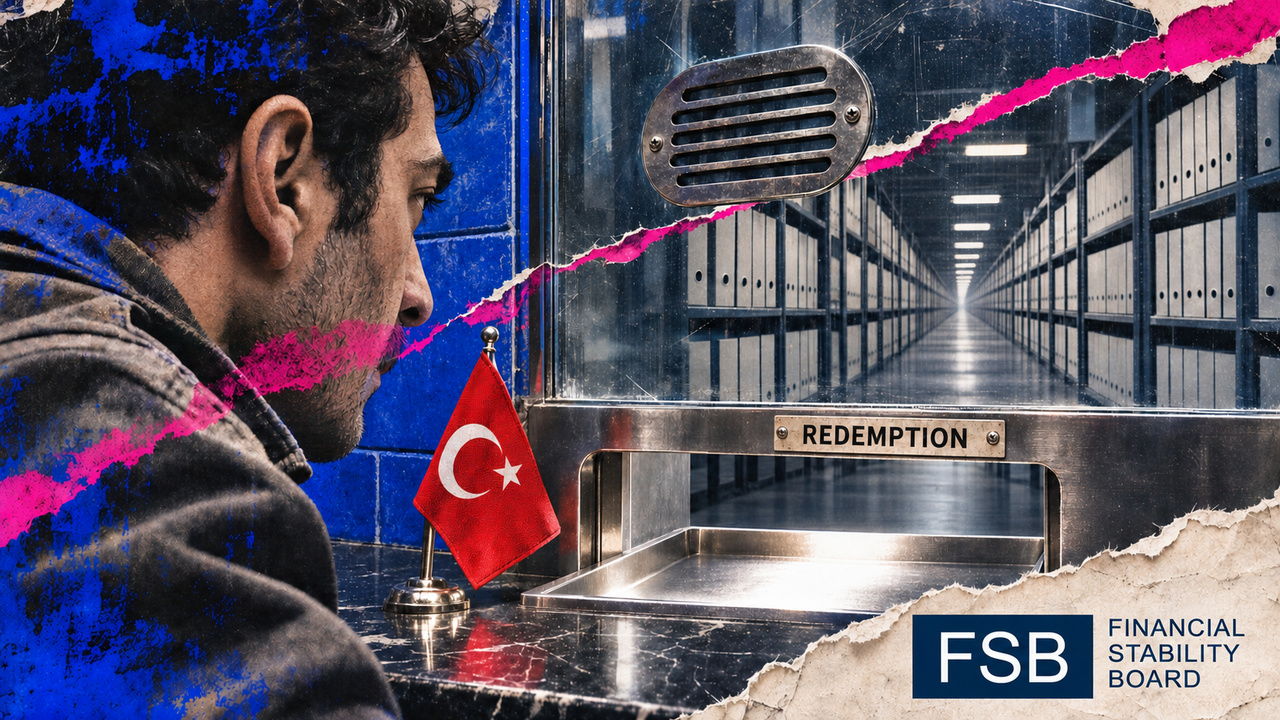
The Financial Stability Board (FSB) has told Turkey to do more about foreign-issued stablecoins that circulate through its local crypto exchanges. In a peer review published Nov. 11, the body called for stronger reserve checks and clearer redemption rights, and it pointed to domestic platforms as the practical lever for overseeing tokens that are issued abroad.
The review is nonbinding and creates no new restrictions or legal obligations. Its value for investors is diagnostic: it shows where an international standard-setter thinks Turkey's rulebook is thin, which is often a preview of where regulators move next.
The assessment reflects reform progress through August 2026. The FSB credited Turkey with progress on crypto-platform registration and licensing, separation of custody, and centralized monitoring. Existing rules already cover distribution, trading and custody, alongside anti-money-laundering controls, limits on certain transfers and a ban on domestic crypto payments.
The gap is stablecoin-specific. The review found no dedicated issuance regime and no tailored listing requirements covering how a token stabilizes its value, how transparent its reserves are, or what its peg history looks like. Those are exactly the questions that matter when a token is issued overseas and bought in lira.
The practical problem is a chain of trust. A buyer on a Turkish exchange holds a token whose backing and redemption arrangements sit with a foreign issuer, and the FSB noted that reserve transparency, redemption practice and incident management can be hard to assess when foreign issuers or their supervisors do not share information.
Stronger oversight of a Turkish distributor could improve scrutiny of those arrangements. It would not, by itself, give customers a new way to cash out, because the recommendations do not create redemption rights. Anyone treating a stablecoin as a safe harbor should keep that distinction in mind.
Local oversight can raise the floor on disclosure, but it cannot turn a foreign promise to redeem into an enforceable local right.
According to the review, stablecoins serve as a store of value, a hedge against lira depreciation and a way to move liquidity between domestic and offshore platforms. That is the demand side, and it explains why regulators watch the segment closely even when official exposure looks small.
Turkish authorities described domestic stablecoin exposures as modest. The FSB warned, however, that wider adoption could increase currency substitution and capital-flow volatility and could put pressure on bank funding. The review also said policy direction and timing had not been set, so there is no deadline for investors to plan around yet.
The FSB's overall message is a coordinated framework that links issuer safeguards, local distribution and cross-border supervision. For researchers following emerging-market crypto policy, the signals to track are whether Turkish regulators publish listing requirements for stablecoins, whether attestations or audits become a condition for trading, and how they handle cooperation with foreign supervisors.
There is also a sequencing point. Because the FSB assessed reforms only through August 2026 and the report sets no timetable, the next moves will come from Turkish regulators rather than from fixed deadlines, which leaves exchanges room to tighten voluntarily ahead of any rule.
For investors, the near-term takeaway is simple. Check what backs any foreign stablecoin you hold, understand who is obliged to redeem it and where, and expect disclosure expectations on Turkish platforms to rise rather than fall.
Keywords: Turkey, FSB, stablecoins, crypto regulation, peer review, redemption rights, lira, reserve transparency
Source: CryptoSlate