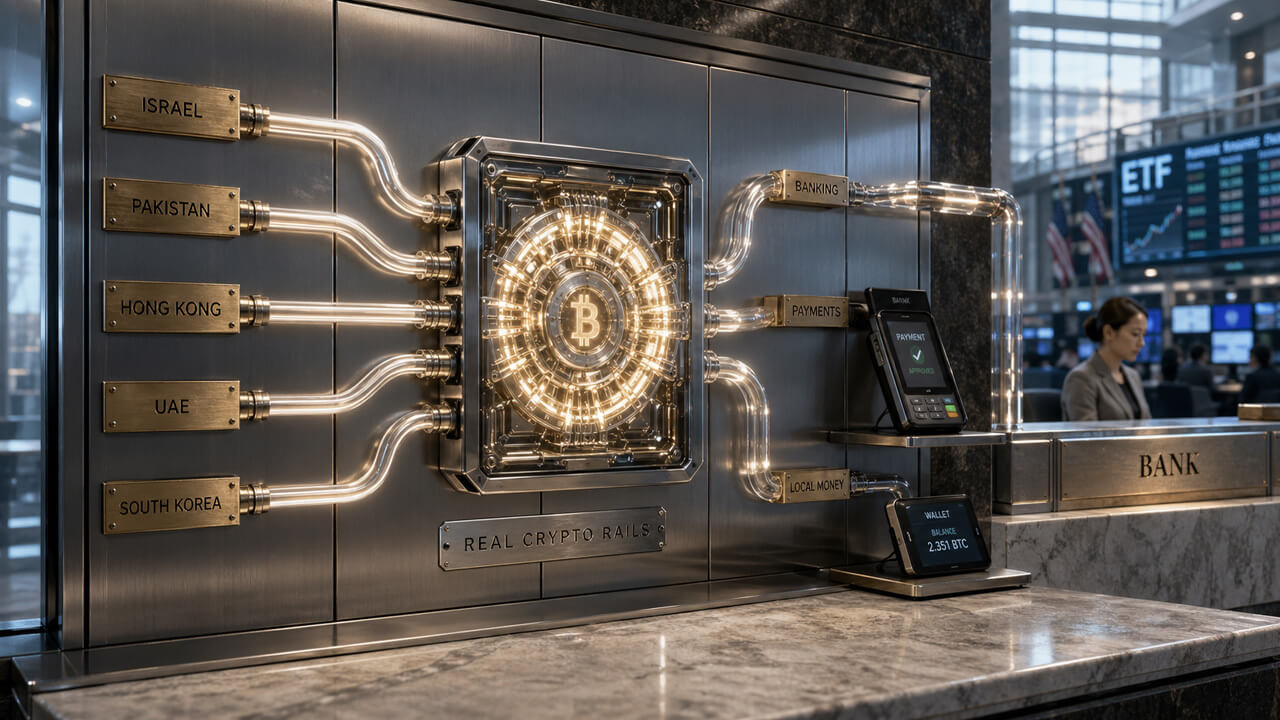
The UAE Central Bank has authorized three institutions to launch a dirham-backed digital settlement coin on a domestic blockchain — a move that signals the Gulf state is no longer just hosting crypto firms, but building sovereign financial infrastructure from the ground up.
In April 2026, International Holding Company (IHC), Sirius, and First Abu Dhabi Bank (FAB) received CBUAE approval to issue the DDSC — Digital Dirham Settlement Coin — on ADI Chain, targeting institutional payments, settlement, treasury management, and trade flows. The announcement came as the UAE's one-year transitional window under Federal Decree-Law No. 6 of 2025 entered its final months, tightening the regulatory vice on every virtual asset service provider operating in or targeting the Emirates.
For investors watching from Riyadh, Manama, or Cairo, the UAE's crypto story in 2026 is less about price speculation and more about infrastructure consolidation. The CBUAE's Payment Token Services Regulation — in force since August 2024 with its transition period ending June 2025 — established a federal licensing framework for any entity issuing, converting, custodying, or transferring stablecoin-style assets pegged to fiat currencies. Algorithmic stablecoins and privacy tokens are explicitly prohibited. Only AED-denominated or approved foreign payment tokens may circulate within the system.
By September 2026, Federal Decree-Law No. 6 of 2025 mandates that every VASP operating in or targeting UAE users must hold a Central Bank license — or cease operations. Administrative fines can reach AED 1 billion; operating without a license is a criminal offence carrying imprisonment and financial penalties between AED 50,000 and AED 500 million. The message from Emirati regulators is unambiguous: the door is open, but the frame is narrowing.
"Traditional financial institutions such as banks are actively exploring their roles within the crypto ecosystem, showcasing the growth of a crypto-TradFi nexus." — Arushi Goel, Head of Policy MENA, Chainalysis
The UAE's on-chain footprint is already substantial. Between July 2023 and June 2024, the country received over $30 billion in crypto, with retail investor activity up more than 75% year-on-year and institutional flows ($1–$10 million transactions) rising over 50% annually. DEX usage — at 32.4% of total transactions versus a global average of 27.8% — reflects a sophisticated market that is simultaneously regulated and decentralized. Total DeFi value received grew 74% year-over-year, a data point that complicates the conventional view of the UAE as a purely institutional-crypto jurisdiction.
The broader regional picture reinforces this momentum. Globally adjusted stablecoin economic volume reached $28 trillion in 2025 according to Chainalysis, with baseline projections pointing toward $719 trillion by 2035. For MENA investors, the dirham-denominated DDSC is not an isolated pilot — it is the UAE inserting itself into the settlement layer of that coming infrastructure wave, on its own terms and currency.
Deepa Raja Carbon, Managing Director of VARA, noted that the authority has identified over a thousand entities conducting crypto-related activity within Dubai and is working through a legacy licensing transition. That transition is entering its enforcement phase. The firms that cleared compliance will inherit a regulated market with institutional-grade on-ramps; those that did not face a hard exit by mid-September 2026.
For investors in the Middle East and broader emerging markets, the signal is clear: the UAE is not building a permissive crypto haven. It is building a permissioned financial system in which crypto is one of the rails — and the dirham, not the dollar, is the unit of settlement for the institutional tier.
Keywords: UAE crypto regulation, DDSC digital dirham, CBUAE stablecoin, VARA licensing 2026, VASP September deadline, Middle East crypto infrastructure, ADI Chain, GCC digital currency, dirham stablecoin, emerging market crypto regulation
Source: CryptoSlate