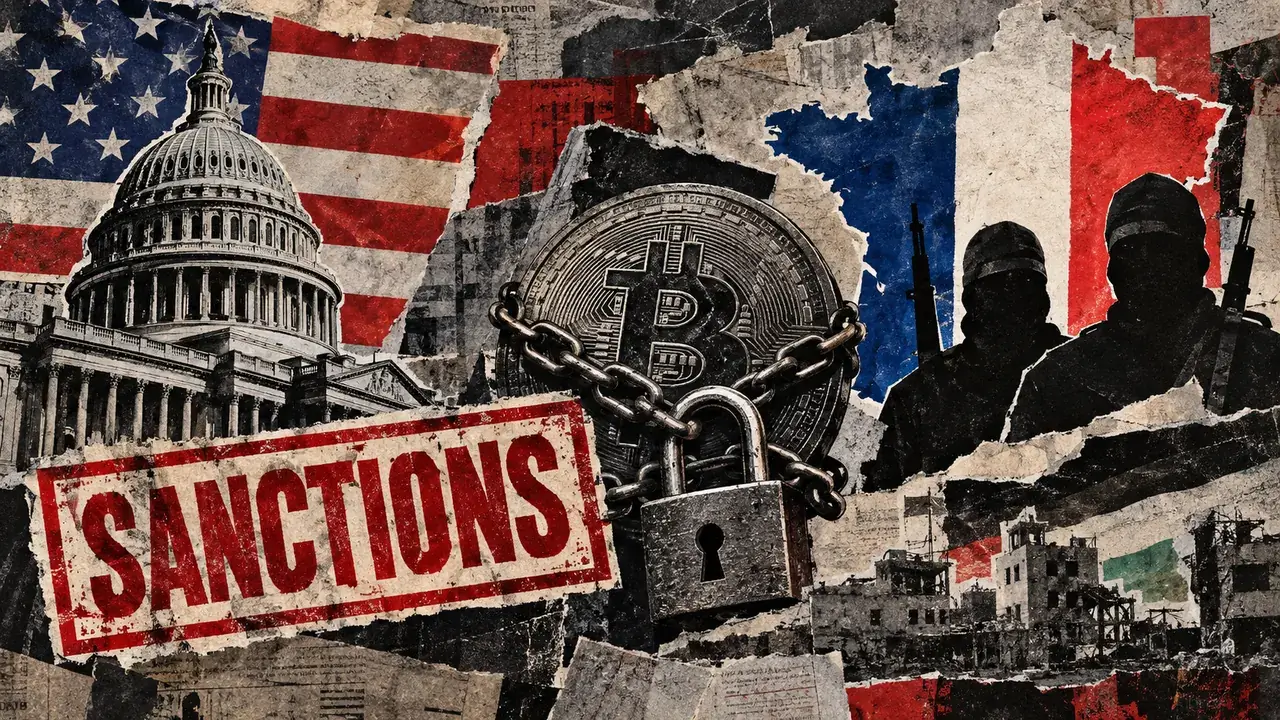
The US Treasury's OFAC has expanded Hamas-related crypto sanctions, designating two French charities and three individuals linked to digital-asset fundraising networks that channeled funds into Gaza. For crypto exchanges and payment processors operating across MENA and emerging markets, the action signals a sharper enforcement posture: blockchain traceability is now a core tool in cross-border sanctions investigations, not a peripheral concern.
The October 2 designations name Association Baraka, Ensemble C Mieux, and individuals Faouzi Barika, Amel Oualid, and Saleem Abdallah Saleem al-Zaq — a Gaza-based figure described as a Hamas military commander. US Treasury alleges that Barika and Oualid transferred hundreds of thousands of dollars in cryptocurrency to al-Zaq, with total fundraising across all channels exceeding $2 million between 2020 and 2026. The expansion demonstrates how US authorities now routinely trace digital-asset flows across jurisdictions as part of broader sanctions enforcement.
OFAC applies the same legal framework to digital assets as it does to fiat currency. US-regulated crypto firms — and foreign firms with US-person exposure or US-dollar-denominated settlements — must block any property belonging to designated parties the moment it comes into their possession or control. The 10-business-day reporting window and annual disclosure requirements apply equally to crypto holdings as to traditional bank balances.
For investors and platforms operating in the Gulf, Levant, and broader MENA region, this enforcement action carries layered implications. First, it reinforces that the blockchain's transparent ledger — often cited as a compliance advantage — is actively being used by US authorities to trace multi-jurisdictional fund flows. Second, it raises the bar for Know-Your-Customer and transaction monitoring protocols at regional exchanges that settle in USD or maintain US banking relationships.
"Treasury's ability to trace cryptocurrency transfers across borders, including from Western Europe into conflict zones, demonstrates that blockchain analytics have matured into a core enforcement instrument — not just a forensic afterthought." — US Treasury OFAC statement context, October 2026
For Gulf-based institutional investors, the enforcement pattern matters beyond direct Hamas-linked exposure. UAE and Saudi Arabia have both made deliberate moves toward crypto regulatory legitimacy — Abu Dhabi's ADGM framework and Dubai's VARA licensing regime are explicitly designed to attract institutional capital by demonstrating AML/CFT credibility. Actions like this OFAC designation create pressure on regional regulators to ensure licensed entities maintain robust sanctions screening, or risk being seen as conduits for sanctioned flows.
The Hamas designations follow a sequence of US enforcement actions targeting crypto networks linked to Iran, Russia, and now Palestinian militant organizations. Each action builds a clearer picture of US enforcement doctrine: digital assets are not a sanctions-free zone, and cross-border flows — even when initiated in allied jurisdictions like France — are subject to OFAC's long-arm reach when US persons, US-dollar infrastructure, or US-regulated entities are involved.
For crypto market participants in emerging markets, the practical takeaway is direct: exchanges and custodians that process USD-denominated transactions or interact with US counterparties need sanctions screening capabilities that match the sophistication of OFAC's own blockchain analytics. The cost of non-compliance — secondary sanctions, correspondent banking cutoffs, and reputational damage — is asymmetrically high relative to the investment required to implement robust screening. In a region where institutional crypto adoption is accelerating, compliance infrastructure is increasingly a prerequisite for serious market participation.
Keywords: Hamas sanctions, OFAC crypto compliance, Middle East crypto regulation, MENA exchanges, blockchain sanctions enforcement, UAE crypto, emerging markets crypto
Source: CryptoSlate