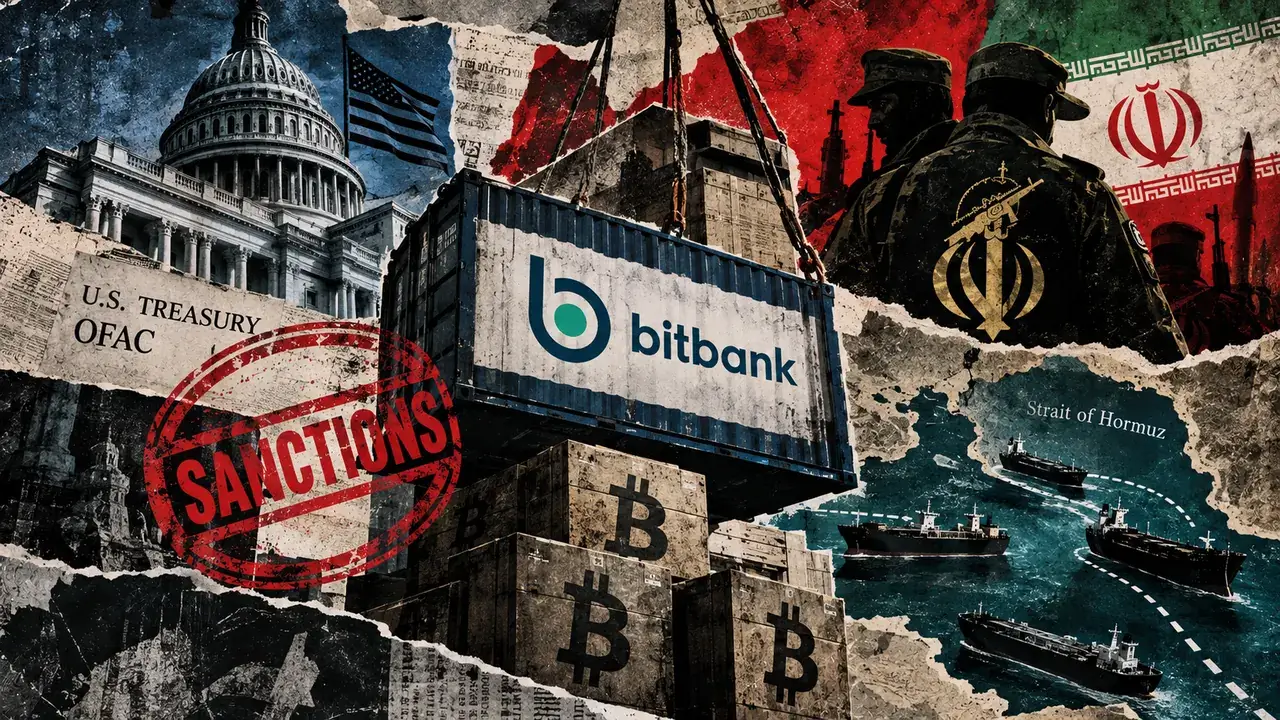
The United States has sanctioned BitBank, an Iran-based cryptocurrency exchange, along with its software infrastructure and three key individuals, marking a significant escalation in Washington's effort to sever the Islamic Revolutionary Guard Corps from global crypto markets. For investors operating across the Middle East, the move signals that OFAC's enforcement reach now extends deep into the region's shadow financial networks — and that no digital-asset intermediary is beyond its scrutiny.
Treasury Secretary Scott Bessent was unambiguous: crypto-based financing is "not beyond OFAC's reach." That warning lands with particular weight in a region where cross-border Bitcoin flows have quietly served as a parallel settlement layer for sanctioned entities, state-linked enterprises, and commodity traders alike.
According to the US Treasury's Office of Foreign Assets Control, between June and July 2026, BitBank allegedly processed hundreds of millions of dollars in Bitcoin transfers routed through the network of Babak Zanjani — a financier already under US sanctions. The exchange served as a conduit for the IRGC, Iran's most powerful military-commercial conglomerate, to move government receipts generated from oil sales and maritime toll collections.
The designations did not stop at the exchange itself. OFAC also sanctioned Pishtaz Simorgh Electronic Trade Company, BitBank's software developer, effectively targeting the technical backbone of the operation. Three individuals — Mohammad Mahdi Zaker Hossein (CEO of Pishtaz Simorgh), Seyed Adel Heidari (vice chairman of affiliated firm Dot One), and Hossein Ali Zaker Hossein (a Zanjani associate) — were named alongside the corporate entities. This infrastructure-plus-personnel approach reflects a matured OFAC playbook: dismantle not just the front-facing exchange, but every layer that keeps it running.
This action is part of Operation Economic Outcast, launched on August 24, 2026, which aims to systematically isolate Iran from the international financial channels it uses for oil revenue recycling and sanctions evasion. BitBank's inclusion expands the operation into crypto-specific infrastructure — a frontier that previous phases had not directly addressed with this degree of technical specificity.
Also linked in the designation is Hormuz Safe Marine Services Authority, previously sanctioned for forcing commercial vessels to pay Bitcoin tolls for safe passage through the Strait of Hormuz. Hormuz reportedly used BitBank from June 2026 onward to move those receipts into spendable form. Together, the entities paint a picture of a layered, crypto-enabled revenue loop: maritime coercion generates Bitcoin, BitBank launders it into the IRGC's operational budget.
For legitimate crypto businesses and investors in the Gulf, the BitBank case is a compliance stress test. The UAE, which extended its grace period for virtual asset service provider licensing to September 2026, and Qatar, which rolled out its digital assets regulatory framework, have both positioned themselves as jurisdictions where rule-of-law crypto infrastructure is the norm. The OFAC action reinforces why that positioning matters: exchanges and developers operating in gray zones — even those with no direct US nexus — now face existential designation risk if their transaction flows touch sanctioned networks.
"Crypto-based financing is not beyond OFAC's reach" — US Treasury Secretary Scott Bessent, September 18, 2026
Middle East-focused crypto investors should read this action on two levels. First, it confirms that sanctions enforcement in the digital-asset space is now as sophisticated as in traditional finance — targeting software vendors and corporate directors, not just exchange front doors. Second, it creates a compliance premium: exchanges and protocols that have invested in robust AML infrastructure and operate under a recognized regulatory framework in the UAE, Bahrain, or Qatar will increasingly be the only counterparties that institutional capital — regional or global — is willing to touch. The bifurcation between compliant Gulf crypto infrastructure and sanctioned shadow networks is accelerating, and the gap will only widen.
Keywords: BitBank, OFAC sanctions, Iran crypto, IRGC Bitcoin, Operation Economic Outcast, Middle East crypto regulation, Babak Zanjani, Gulf crypto compliance
Source: CryptoSlate